
David, Jonathan, and colleagues from the Madidi Metabolomics Project–part of the Madidi Project–publish a paper in Ecology titled “Testing the role of biotic interactions in shaping elevational diversity gradients: An ecological metabolomics approach”.
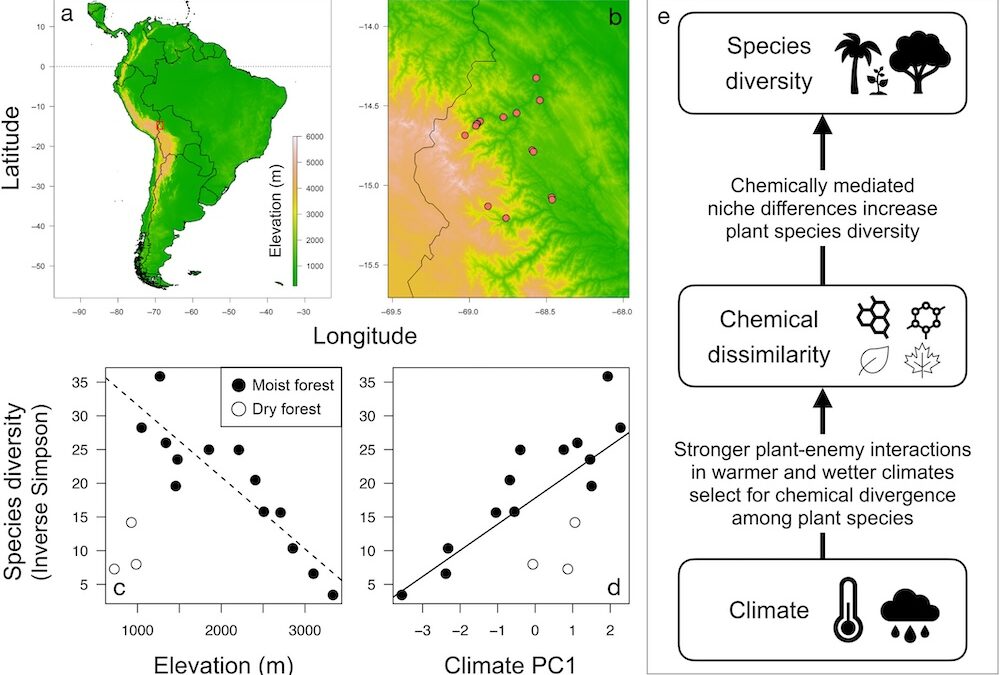
Figure 1: Overview of 1-ha forest plots used to test effects of climate and chemical dissimilarity on tree species diversity. (a) Location of study region in northwest Bolivia. (b) Distribution of plots along the eastern slopes of the Andes Mountains (662–3324 m) in and around the Madidi region. (c) Relationship between tree species diversity (inverse Simpson’s index) and elevation. (d) Relationship between tree species diversity (inverse Simpson’s index) and climate (PC1: precipitation and temperature). The dashed line in (c) shows a linear regression excluding the three seasonally dry forest plots (white circles) (df = 11, p < 0.0001, adjusted R 2 = 0.77). The solid line in (d) shows a linear regression including all 16 forest plots (df = 14, p = 0.0019, adjusted R 2 = 0.47). Elevation data (color scale bar) from WorldClim (www.worldclim.org). (e) Overview of the hypothesis linking climate and chemical dissimilarity to tree species diversity, illustrated with the meta model for the piecewise structural equation model (SEM) used to test Prediction 1 (bottom arrow: indirect effect of climate on species diversity through chemical dissimilarity) and Prediction 2 (top arrow: direct effect of chemical dissimilarity on species diversity). (e) created by J. Myers. PC, principal component.